SACRED MUSIC LITURGICAL MUSIC
THE EVOLUTION OF SACRED MUSIC HAS ALWAYS PUSHED AGAINST THE ESTABLISHED ORDER ! First of all, it is essential to distinguish between liturgical music and Sacred Music. Liturgical Music, whether of cults or religious is intended to accompany ceremonies. It is not especially vocational as art, but has simply to support prayer, as a litany suggesting angelic choirs. Sacred Music, on the contrary, makes reference not only to the spirituality, but also to musical art and to beauty : well beyond the doctrine, it attempts to mystically symbolise the divine* and the sublimity.
The first Christians favoured a simple incantation, without seeking to achieve any aesthetic value : they created Plain-chant stemming from Greek modes, Jewish psalms and Roman songs. The gregorien chant,taken from the name of the pope Gregory 1st, was first truly refined musical expression and appeared five centuries later. Austere and magnificent, it is a monody without any instrumental accompaniment, chanted in unison by the monks. The Gregorian chant has to marry faithfully the to text of Scriptures. It is sung in Latin, which was then the compulsory language for the entire Christian church. When the first musical notation appeared, notes were represented by the first few letters of the alphabet, but the measure still did not exist: the interpretation of the Gregorian followed the rhythm of the words… The Gregorian chant reigned during 5 centuries. However composers followed their natural tendency to further develop religious music. CD OF GREGORIAN SACRED MUSIC Gregorian chant - Choir of the monks of Solesmes: Plain song and Gregorian chant of the monks from the abbey of Solesmes. CD - The song of silence, Gregorian chant. In the 12 century, at the time of the Gothic cathedrals, new influences, partially inspired by the troubadours began to disturb the established order of the Gregorian. They allowed the Sacred Music - by freeing it from the narrow codification of dogma - to reveal a more elaborated and richer aesthetic, and eventually, to better to serve religion. THE NEW SACRED POLYPHONIC MUSIC - CANON POLYPHONY - COUNTERPOINT - HARMONY - RHYTHM A wave of novelties developed during the following centuries: the introduction of the polyphony, the counterpoint, harmony, rhythm, notation and musical publishing, and for the first time for twelve centuries, the use of musical instruments in Sacred Music. Polyphony is the basis of music for centuries to come. It consists of interlacing and combining several different melodic lines - or voices -, played or sung simultaneously. This system of musical composition, which appeared in the church in the 9th century in music from the Middle Ages, and developed until the end of the Renaissance. The melody is the main song of a piece, which gives the "air" of a composition, the accompaniment being based on harmony. The melody therefore defines the essential instrumental or vocal part which scrolls "horizontally" on the thematic line of the score. Each note of a melody is determined by the interval which separates it from the fundamental or tonic note. The concept of melody is thus opposed to that of harmony, but not necessarily that of polyphony, which combines several melodic lines between them. Harmony or the science of chords, organized sounds "vertically": a chord consists of a minimum of three notes of different pitch played simultaneously. As musical notation l evolved : full and empty notes as well as red or black notes, aided their reading. The Canon consists of a rigorous reproduction or imitation of the same melodic drawing after a fixed space of time. Until the 16th century, the cannon was called hunting or fuga. The counterpoint, and the imitative counterpoint, based on the "Canon" would later lead to the Fugue, superimposed melodic lines, and thus represent the first type of "horizontal" harmonization. Rhythm became modernized : the symbolism of the figure 3 ( in the mystery of the Trinity, God is three in one, the Father, the Son and Holy Ghost ) had been the sole admitted to be a "perfect mode ", but the opening of binary values "imperfect modes" which divides the long into two breves. But the march of progress never advances without resistance and it aroused violent objections : Pope John XXII condemned this "shameful" music. Dominican and Cistercian monks banished the new music from their ceremonies… But subjugated by the force of innovation, the Church eventually accepted it. The reform of the Lutheran churche, which abandoned Latin, permitted the development of the "chorale" henceforth written in everyday language. The bass monody accompaniment - or only the melody and the bass were written, leaving to the interpreter the choice of accompaniment - and developed later between the Renaissance and the baroque movement. CD OF POLYPHONIC MUSIC PALESTRINA revisited by the Bulgaria Jar Ensemble - Missal Prime Toni.
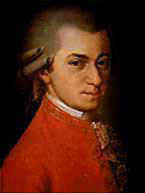
MOZART's work in Sacred Music is grandiose, excellent examples are his masses such as the mass in C minor and his extraordinary Requiem. As everyone knows, MOZART was interred in a communal grave after his death... CD OF W.-A. MOZART'S SACRED MUSIC Requiem by Herbert Von KARAJAN - Masse in C minor by Herbert Von KARAJAN. FROM THE ROMANTIC PERIOD TO EXPRESSIONISM An Impasse was temporarily reached during this period, in spite of its rich fund of composers of Sacred Music. We shall return to consider this later. However let us remind ourselves of the names of the sublime RACHMANINOV and his "Vespers", VIERNE, DURUFLÉ... CD OF ROMANTIC SACRED MUSICI DURUFLÉ : Requiem - RACHMANINOV : Vespers - Jehan ALAIN : Litanies SACRED MUSIC TODAY Sacred Music makes us aware of the works of all times and all cultures. If it is true that "Classic" Sacred Music will always preserve its letters of nobility, the other forms of expression have reached the people : thus in the USA the black people express their faith through Gospel and the Negro spiritual... In Africa a " Mass of savanas " is sung, in Argentinta the "Missa criolla"... Modern forms of Sacred Music, which do not simply reproduce the fashions of the past, blossom all over the world. CD OF GOSPEL SACRED MUSIC Gospel - Oh Happy Day by Edwin HAWKINS Singers. New Gospel by MONTREAL JUBILATION Gospel Choirs.
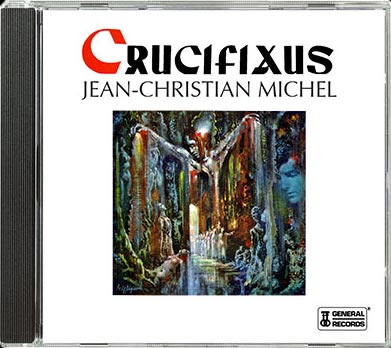
We have seen that Sacred Music, references spirituality, musical art and beauty : Jean-Christian Michel's Sacred Music, a song of hope and peace, expresses the feelings of the soul at its most elevated and translates them with its audacious architecture, its power of life and its fervour. To experience this, it is enough to be attentive to the silence which reigns over the audience during one of his concerts ! "A REAL ARTIST IS IN DISCORD WITH THE ARTISTIC PROPOSITIONS OF HIS TIME" Challenging the established order with a spiritually innovative music different in all respects from those of the past, propels "Sacred Music" to the fore front of current events, Jean-Christian Michel arouses passionate reactions which leave no-one indifferent. One understands that, in this context, he has been able to arouse as many enthusiastic loyalties as he has deliberate enmities, as much love as hatred, friendships as hostilities. A million music lovers have entered his musical universe, and appreciate the authenticity of his music. In addition the gibes of a small rear-guard of reactionary "musicophiles" have not succeeded in demeaning the spiritual character of his work. Can one seriously think that one piece or type of music is "more sacred" or "less sacred" than another? The vault of the cathedrals has never refused the resonances emanating from archives of the heart. CD OF JEAN-CHRISTIAN MICHEL'S SACRED MUSIC REQUIEM, SACRED MUSIC, CRUCIFIXUS. * Divine : that which makes reference to a principle of explanation of the existence of the world (according to the particular modalities of faiths and religions).
|
||||||||||||||||||||||||||||||||||||||||||||||||||||||||||||||||||||||||||||||||||||||||||||||||||||||||||||||||||||||||||||||||||