JAZZ AND SACREDMUSIC :
Jean-Christian Michel, played transcriptions of J.-S. Bach's, before
composing his own music.
WHAT WOULD JOHANN-SEBASTIAN BACH HAVE LOVED?
I
- JOHANN-SEBASTIAN BACH GENIUS
OF CLASSICAL MUSIC
With
illustrative CD
BRIEF
BIOGRAPHY OF JOHANN-SEBASTIAN BACH
Johann
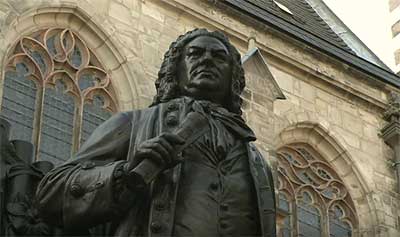
Sébastian BACH was born at Eisenach
THE LIFE OF JOHANN-SEBASTIAN BACH ( J.-S. Bach's BIOGRAPHY)
EISENACH
1685-1695
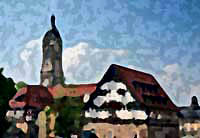
Johann Sébastian BACH was born at Eisenach in Thuringia,
eastern Germany on March 21, 1685, into an extraordinary family
of musicians. He was introduced to Music by the church organist but it was his brother Johann Christoph
who first revealed to him the true secrets of the organ.
OHRDRUF
1695-1700
He studied and passed with distinction the exams at Ohrdruf's
boarding school.
LÜNEBURG
1700-1702
At the age of 15 Johann Sebastian was in Lüneburg where he
worked as a singer at the Latin school for two years. He was able
to find and study a great many rare musical manuscripts, and when
he left Lüneburg he was already a brilliant organist.
ARMSTADT
AND MÜHLHAUSEN 1703-1710
Johann-Sebastian
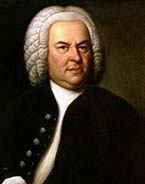
BACH Organist and composer
At 18, Johann Sebastian became " secretary - violinist "
to the court of the Duke de Saxe-Weimar, then, in the same year,
organist at Armstadt's church. He took a sabbatical to go and
study with the famous Buxtehude. To so do he did not hesitate
to walk more than 300 km! His stay lasted too long, according
to his employers, and he lost his position at Armstadt: However
his art metamorphosed at the school of the Grand Master …
Johann
Sebastian obtained, at 21, the prestigious post of organist to
the town, in Mühlhausen's church. In the same year he married
his cousin, Maria Barbara BACH with whom he had six children.
WEIMAR
1710-1717
The following year Johann Sebastian BACH moved to Weimar and became
concert organist and director, a post he held for 9 years, it
was during this period that he composed many of his religious
cantatas and organ pieces. His mastery of the organ and the Fugue,
since then unequalled in Europe, quickly made him famous and brought
numerous invitations.
However
Johann Sebastian BACH was a musical genius, not a courtier, and
had little talent for political intrigue. It was because of this
that the post of choirmaster was refused: Offended, he left Weimar.
KÖTHEN
1717-1723
By this time Johann Sebastian BACH was 31. He was chosen to direct
the orchestra of the court of Köthen, and stayed at this
post for seven years. He moved a little away from Sacred Music,
to dedicate himself more to instrumental music: he composed the
Brandenburg Concertos and the Well-Tempered Clavier vol 1…
His
wife died when Johann Sebastian BACH was 35. He later married
Anna Magdalena Wilcken who was barely twenty years old ( she would
give him 13 children some of whom would become brilliant composers
e.g. Karl Emmanuel BACH or Johann-Christian BACH …)
LEIPZIG
1723-1750
Johann Sebastian BACH had just celebrated his 38th birthday when
he settled in Leipzig where he stayed until his death. He had
just obtained the post of Cantor to Saint Thomas' church. Naturally
it was a prestigious post, but a tiring one because Johann Sebastian
BACH was obliged to compose for the 4 churches of the city, to
conduct choirs and to teach Latin in the church…
At
44 Johann Sebastian BACH also took over the management of the
Collegium Musicum. He composed the Cantatas and the great Oratorios.
Johann Sebastian BACH's working week was not limited to 35 hours!
At
51, in addition to his post of Cantor to Leipzig he was named
as "Choirmaster" of Dresden and as composer to Frédéric
Auguste, Elector of Saxony. The city of Dresden possessesd an
intense cultural and musical life. This is the period when Johann
Sebastian BACH composed the Goldberg Variations, the canonical
Variations, Well-Tempered Clavier vol 2, the Art of Fugue and
Mass in B minor.
Serious
health problems affected the composer. Cataracts made him almost
blind. He died of a heart attack at the age of 65 in 1750.
Johann Sebastian BACH was the unequalled master of baroque music,
the god of the Fugue and of the counterpoint and certainly one
of the greatest geniuses in the history of Classical music.
His multi-dimensional and unlimited vision timelessly engraves
him on the universality of all music.
JOHANN-SEBASTIAN BACH'S WORK
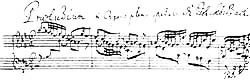
Johann
Sebastian BACH's
score
Fascinated by his art, an indefatigable worker who was constantly
obliged to work to support his big family, Johann Sebastian BACH
composed a monumental amount of works: Sonatas, Préludes, Trios,
Fugues, Fantasies, Fantasies and Fuges, Préludes and Fuges, Toccatas
and Fuges, Cantatas, Chorals for organ, Motets, Passacailles,
Variations, about twenty Concertos, Oratorios, a Magnificat, Masses,
two Passions…. all of a sublime beauty and so perfectly written
that one cannot listen to these marvels without being delighted
and admiring.
- JOHANN-SEBASTIAN BACH AT THE ORGAN
Virtuoso organist, exceptional improviser, in forty years Johann
Sebastian BACH wrote innumerable pieces for the organ. 27 Préludes,
Toccatas or Fantasies and Fugues, Concertos, Trios, Sonatas, Orgelbüchlein
Chorals. It is on paper and on the organ, his preferred instrument
that he composed most of his works.
A
MAGNIFISCENT CD of J.-S. Bach : Sonatas in trio BWV 525-530 by Marie-Claire
ALAIN
- THE ART OF THE FUGUE by JOHANN-SEBASTIAN
BACH.
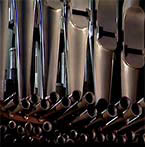
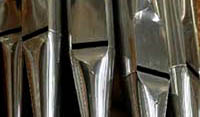
Church
pipe organ "on show
The Fugue is a musical piece written according to very strict
compositional rules. Based on imitation, it starts with a main
musical theme initially played alone, then repeated with variations
as a response, by different instruments.
The
theme is often accompanied in counterpoint by a secondary theme
called the counter-theme. When the theme and the responses have
been fully developed in the dominant and in all the nearby tones
and by all the voices, the strette or final part reprises with
increasing rapidity the main themes of the piece.
Johann
Sebastian BACH, is the Grand Master of the Fugue and the counterpoint.
Endowed with an extraordinary inspiration, he exploits all the
resources of polyphony and, at the end of the life, half blind,
he was forced to dictate his " Art of the Fugue" being
unable to finish it himself.
A
CD OF GRANDIOSE J.-S. Bach : J.-S. Bach, Art of the Fugue BWV 1080 by
Marie-Claire ALAIN.
Matthäus Passion - Herbert Von Karajan - Clip Réalisation Jean-Christian Michel
Johann Sebastian BACH's work is that of a genius and a profoundly
religious man. He succeeds in transcribing his profound spiritual
strength in sublime enchanting music, as complex as it is harmonious.
Johann
Sebastian BACH's Chorals, his religious Cantatas, his Masses -
particularly the Mass in B minor - the Magnificat, the Oratorios
and the Passions - immense Oratorios for choir and orchestra -
make up his Sacred Music. The Passion according to St Matthew,
and the Passion according to St John, are among the richest of
all music.
The
Choral remains one of the pillars of the church music : a religious
hymn, drawn from the secular and the Sacred traditions, Johann-Sebastian
BACH is famous for developing this genre to it's highest level.
TWO
CD OF J.-S. Bach are absolutely unmissable : J.-S. Bach: Matthäus-Passion
by Herbert Von KARAJAN and J.-S. Bach : Johannes Passion by György
Lehel.
JOHANN-SEBASTIAN BACH'S CONTRIBUTION TO MODERN MUSIC.
Johann Sebastian BACH's work established the foundation of all
modern western music. MOZART would be able to write his sonatas, his masses and operas, on
the very solid foundations constructed by Johann Sebastian BACH!
One
could say that all the musicians who succeeded Johann Sebastian
BACH benefited from the contribution. Numerous composers were
inspired directly by the Cantor of Leipzig, such as Gounod in
his Ave Maria, or RAVEL vigorously separating himself from the
revitalised impressionism through a writing style of " BACH
back to front " …
Johann
Sebastian BACH's music carries within itself the roots of numerous
aspects of the Jazz: leaving lots of room for improvisation, it
also possesses in its structure a rhythmic dynamic which turns
within itself and prefigured "swing". *
II
-JAZZ AND CLASSICAL
- JAZZ BACH
With some
recommended CD
JAZZ
Improvisation was commonplace in Music before the advent of the romantic movement in music. Well before
BACH - practically since the time of the monody with continuous
bass - the least musician knew how to improvise within a piece.
Athough improvisation diminished in Classical music, it reappeared
in force in Jazz .
Swing
- a beat drawn from syncopated rhythms - and expressiveness -
phrasing, sound's work and feeling ( a sensitivity particular
to Jazz musicians ) - these are the main characteristics of Jazz.
Born
in the cotton fields of New Orleans, inspired in its origins by
Lutheran Chorals singing, made poignant by its " blue note
", Jazz gradually became increasingly sophisticated , then
intellectualized to finally develop into version one could call
"European", more elaborate and combining classicism
and modernity.
Louis
ARMSTRONG is a Jazz genius comparable to J.-S. Bach in Classical
music. Three big Jazz names on the clarinet: Jan GARBAREK, Sidney
BECHET and Mezz Mezzrow.
UNMISSABLE
JAZZ CD : Louis Armstrong, Series Hot five and Hot seven.
INFLUENCE OF JAZZ ON CLASSICAL MUSIC
"It has been certain that, since Jazz has existed, nothing
will ever be the same in Classical music":
From PENDERECKI to BOULEZ until today, music has not stopped evolving.
Composers like BARTOK, ANSERMET, STRAVINSKY, or GERSHWIN were
inspired by or wrote for Jazz.
At
the same time, a new generation of contemporary Jazz interpreters
grew up with a new vision of music. Samson François and
Glenn GOULD opened the road. Chick COREA adopts a thorough approach
by deviating from conformist interpretations, with an unmatched
musicality in his "MOZART sessions"..
RECOMMENDED
CD OF CLASSICAL MUSIC : Glenn GOULD plays BACH - Italian Concerto
etc... - Chick COREA and Bobby Mc FERRIN : The MOZART SESSIONS.
Arrangers
have transcribed J. -S. BACH in Jazz, composers have integrated him
into their work, creating a new musical style: Gerry MULLIGAN,
George SHEARING Bill EVANS, John Lewis's MODERN JAZZ QUARTET,
Milt Jackson and Kenny Clarke in the CD " Blues on BACH ",
SWINGLE SINGERS, Jacques Loussier with his CD " PLAYS BACH
", CLASSICAL JAZZ QUARTET of Daniel HUMAIR and Guy PEDERSEN
and finally Jean-Christian Michel, to quote but a few, have benefited
from a Classical culture and refer to ( and honour ) Johann Sebastian
BACH.
JAZZ
TRANSCRIPTIONS FROM JOHANN SEBASTIAN BACH'S MUSIC.
Johann
Sebastian BACH's music lends itself very well to Jazz transcription.
Its rhythmic ease allows the accentuation of weaker beats without
betrayal, and by bringing together the structure with swing (
double time crochets ) or syncopated rhythms actually more modern
and more elegant than their precedents, ( accentuated crochets
), one is able to create beats and the basic swing of Black American
music. An excellent example is supplied with the " Trio in
minor C " transcribed by Jean-Christian Michel.
RECOMMENDED
"JAZZ and CLASSICAL" CD : Blues on BACH, Django by
MODERN JAZZ QUARTET and PLAY BACH, Italian Concertos by Jacques Loussier.
JAZZ AND SACRED MUSIC-
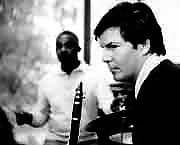
Recording
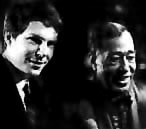
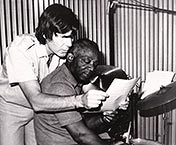
with Kenny Clarke
Jean-Christian Michel
with Duke Ellington
Kenny
Clarke from the MJQ
When
listening to Jean-Christian Michel for the first time, one is
amazed to discover a completely new sound of clarinet, organ, synthesizers and percussion.
We
discover a unique form of composition and improvisation. Jean-Christian Michel has invented a unique musical style based on Jazz
and Sacred Music. The vitality and expressiveness of Jazz
extends the depths and mystic dimensions of Sacred Music.
His
sensorial clarinet playing and a "feeling" totally his
own allow one to recognize him amongst a thousand others.... With
the contribution of Jazz, Classical music gains a new dimension
and the inverse in also true.
JEAN-CHRISTIAN MICHEL TRANSCRIBES JOHANN-SEBASTIAN BACH THEN COMPOSES
HIS OWN MUSIC.
"Fugue étincelante", a Jazz-Classical work by Jean-Christian Michel - (CD Musique de Lumière
Jean-Christian Michel composes his own themes. Many of them are imprinted with
the spirit of the Cantor of Leipzig. His "Fugue Etincelante"
(Sparkling Fugue) is a model of
the genre: it is an authentic Fugue with
theme, counter-themes, displays of nearby tones, entertainments
and finale ! A little marvel in the baroque style which would
not have shamed Johann Sebastian BACH.
Jean-Christian Michel, in certain pieces, succeeds in breaking musical limitations
imposed by the score : For example in the Choral BWV 727: "Herzlich
tut mich verlangen" the bass pedal part, transposed up 3
octaves is played on the synthesizer as a flute with portamento
effect. This voice illuminates the piece like a ray of light from
above and offers a new vision of the work. Johann Sebastian BACH's
writing is not betrayed - there is little to displease the purists
or the narrow-minded, only a clarinet interpretation magnificently free of constraint suggests Jazz
.
Jean-Christian Michel has not only studied Bach, but also Debussy, Ravel,Satie, Vierne and Jehan Alain. A truly complete musician
he played Jazz throughout his adolescence.
Although
his art is marked by the enriching influence of the Cantor, he
quickly found his own creative path, composing remarkable works
such as the Concerto of Port Maria and Ezéchiel's Vision.
Often
accompanied by Kenny Clarke, percussionist from the MODERN JAZZ
QUARTET, Daniel HUMAIR and Guy PEDERSEN, Jean-Christian Michel
proves that solid technique, a knowledge of the Fugue and counterpoint,
are not unimportant, if one really wants to win a place at the
pantheon of the great musicians.
WOULD JOHANN SEBASTIAN BACH HAVE LIKED IT
?
PLEASE,
READ WHAT THE PRESS THINKS - (Numerous
extremely positive reviews, notably during the diverse "
BACH TAGE " in Germany - cradle of Johann Sebastian BACH's
music).
Three unmissable CD by Jean-Christian Michel : Port Maria, Musique de lumière ( Music of Light
) and "@ranjuez" ( new arrangement of Aranjuez's
Concerto ), "J.-S. Bach TRANSCRIPTIONS..
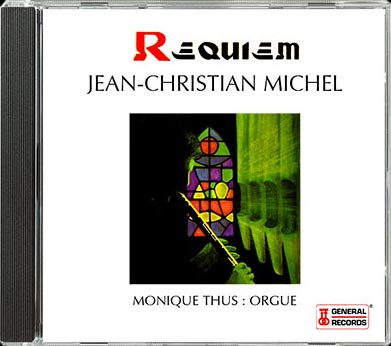
A fantastic CD by Jean-Christian Michel and his musicians, with Monique THUS, organ. The multidimensional sounds of the organ and synthesizers take over space in a mystical atmosphere.
Requiem
- Fugue en Sol Mineur - My Soul Longeth To Depart In
Peace - Unto The I Cry, O Lord Jesus - Choral N°
45 BWV 709 Seigneur, tourne toi vers nous - Missa Sine Nomine - Oratorio de Noel -
Miserere - Prélude en La Mineur "Anna" - Adagio et Fugue en Fa Majeur - Choral Spiritus alter .
VISIT THE PAGE : DISCS & CD OF JEAN-CHRISTIAN MICHEL









 DÉCOUVREZ