THE MAGIC UNIVERSE OF RECORDING STUDIO
Capturing the sound of the clarinet, the organ and the synthesizers - Creating a CD - Encoding on MP3 PRO or RealAudio - BACH's Sacred Music recorded with computer-controlled synthesizer.
Finally the studio permits one to conceive and prepare the perfect sound system that will allow the show to be enjoyed to its full. That's why Jean-Christian Michel became so attached to the mastery of these disciplines... 1 - ARCHITECTURE OF THE RECORDING STUDIO
2 - RECORDING STUDIO ÉQUIPEMENT The studio includes a recording room, a small separate room for the drum kit or any instrument which needs to be isolated, and a mixing booth. IN THE RECORDING ROOM : In the recording room are the musical instruments, microphones, stands, connecting cables, monitor headphones etc. On the baseboards, 220 V electrical sockets, and XLR boxes connected to the recording console by miles of cables. IN THE MIXING BOOTH The central nervous system of the studio : an assortment of high-tech instruments : dispatching console, amplis, monitors, track-recorders, Dat, autolocators, computers, amplifiers and monitors, and stacked in their system stands, reverbs, echos and digital delays, noise-gates, phasers, flangers, harmonisers, equalisers, enhancers, compressors, too many to remember. 3 - UNDERSTANDING THE ÉQUIPEMENT OF THE RECORDING STUDIO
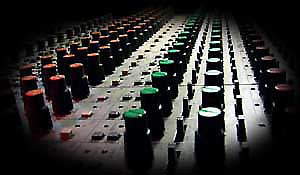
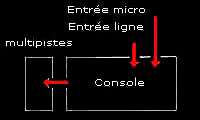
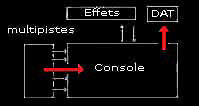
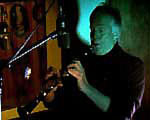
Today almost all recordings are made by the technique of multiple tracks on one tape - tape recorders ( analogue ), digital recorders or directly onto computer (Mac rather than PC) all are the same in terms of understanding the functioning of the system. The multitrack technique offers the huge advantage of ease of use combined with an unequalled clarity in the finished product : It allows direct recording, tracking (copying one track to another) and re-recording (recording musicians at the same time as they listen to that which has already been recorded on the tape). Sounds distributed on separate tracks will then be mixed. For reasons of cost and convenience, the computer takes the track bit by bit from the analogical track-recorder. Digital sound doesn't have the "breath" of tape, and although it possesses wider dynamics, it remains less fine and less "warm" than analogue sound. Americans are now returning to analogue equipment, particularly for instruments such as the clarinet. How to combine these two techniques ? THE CONSOLE In the heart of studio, there is a console. It manages the recording operations and also tracking and mixing. It must have at least as many channels as the recorder has tracks, in order to be able to mix them. We shall not enter into too much detail and shall only describe the essential functions of a console which allow it to receive and to send, to correct or to mix signals coming in from the synthesizers, from microphones, or from for multitrack recorders or various other peripherals …These amplified signals are listened on the monitors during the recording or the mixing. PERIPHERALS OR EFFECTS These are reverbs and digital delays, equalisers, compressors, phasers, flangers etc. which "embellish" the sound in the mix or to give it a colour or a particular density. 4 - USE OF THE CONSOLE IN THE RECORDING Every channel on the console, (corresponding to a track on the multitrack), permits a wide range of modifications : - the equalisation modifies the frequencies, by correcting low, medium and high. - The auxiliaries allow the input of different effects : for example, reverb will prolong sound as if it had been recorded in the vault of a cathedral. - Faders adjust the balance of instruments. - Finally whereas the panoramic potentiometers distribute the stereo space left - right, the auxiliary controls are the delays which will modify the depth of the sound space … Creating a CD requires numerous stages. First of all you have to record the "direct input" instruments : The rhythm section, bass and drum kit, digital percussions kit, synthesizers, electric guitars etc. Then you must capture the sound of the acoustic instruments : clarinet, pipe organ, Classical guitar, violins etc. When all the instruments have been recorded, each of them on one (or two for Stereo) different tracks, it is useful to "clean" the "whites" on the tracks. Afterwards, only the mixing remains, to create the "master for edit". This, compiled to computer and processed by a sound editing software, will give the definitive master. This last will be sent to the CD factory to be fabricated. 7-THE SOUND RECORDING OF INSTRUMENTS
8- THE MASTERING AND THE BURNING OF THE CD
A little word in passing about MP3 PRO. This new type of compression combines the algorithm of MP3, well known by the Internet users, with "Spectral Band Replication" (SBR) technology which permits the restoration of frequencies between 13-15.000 Hz and consequently allows a sound compression of greater quality. The streaming format allows you to listen directly, almost immediatly without downloading. In fact, while you're listening to the beginning, RealAudio continues to load the rest of the piece. For more information : RealAudio at https://www.real.com The encoding from Wave< format (as with an audio CD) in the RealAudio format has been done with Real Networks' Helix Producer.
Computers and synthesizers do not "dehumanize" music and do not in any way damage its soul. On the contrary, they allow the creator to draw new sounds, to leave more open the route for his imagination when developing masterful orchestrations. Computers and synthesizers do not "dehumanize" music and do not in any way damage its soul. On the contrary, they allow the creator to draw new sounds, to leave more open the route for his imagination when developing masterful orchestrations. Computers will never "replace" man, because it is always he who is behind the machine, who dictates its program and gives it orders. Music software simply allows the irreproachable execution of its scores, henceforth transformed into "MIDI files". Be reassured, the technique is there only to serve culture, imagination and the dreams of the musician. Who would have thought that one day, J.-S. Bach's Sacred Music would be played on the clarinet, the organ and by Computer Assisted Music !
JEAN-CHRISTIAN MICHEL'S REFERENCES Jean-Christian Michel worked with great sound engineers such as Francis Miannay, Jacques Lubin and Gerhardt Lehner at the Barclay studios in Paris, Jean-Claude Egreteau at CBS studio, and Mike Sharp in Los Angeles in the USA... Jean-Christian Michel manages his own professional recording studio, and has considered useful to propose some elements of reference to those who would like to get their own HOME studio, or to have an additional lighting to realize certain specialized sound recordings (as the sound recording of clarinet, for example).
|
|||||||||||||||||||||||||||||||||||||||||||||||||||||||||||||||||||||||||||||||||||||||||||||||||||||||||||||||||||||||||||||||||||||||||||||||||||||||||||||||||